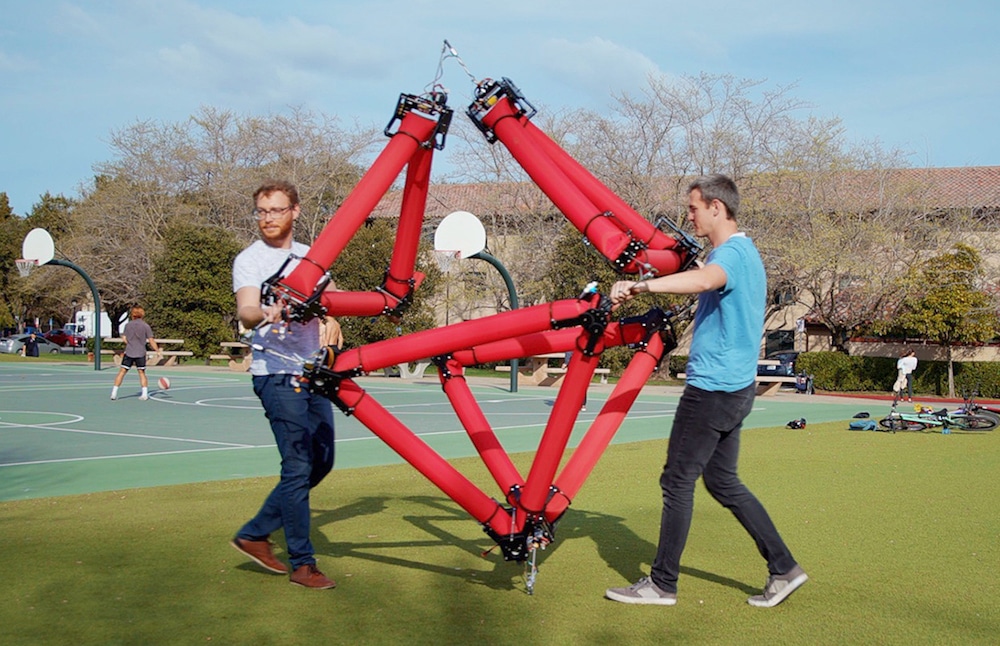
Graduate students Zachary Hammond (on left) and Nathan Usevitch pick up and move the isoperimetric robot, demonstrating that it is lightweight, resistant to damage and safe around humans. Credit: Farrin Abbott/Stanford University News
Advances in soft robotics could someday allow robots to work alongside humans, helping them lift heavy objects or carrying them out of danger. As a step toward that future, Stanford University researchers have developed a new kind of soft robot that, by borrowing features from traditional robotics, is safe while still retaining the ability to move and change shape.
The post Stanford developing tetherless soft robot that changes shape appeared first on The Robot Report.