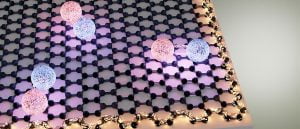
In Novel Quantum Computer Design, Qubits Use Magnets to Selectively Communicate

When you push a button to open a garage door, it doesn’t open every garage door in the neighborhood; that’s because the opener and the door are communicating using a specific microwave frequency, a frequency no other nearby door is using.

Researchers from the University of Chicago, the US Department of Energy’s (DOE) Argonne National Laboratory, the University of Iowa, and Tohoku University in Japan have begun to develop devices that could use the same principles—sending signals through magnets instead of through the air—to connect individual qubits across a chip, as reported in a new paper published in the Proceedings of the National Academy of Sciences.

The post In Novel Quantum Computer Design, Qubits Use Magnets to Selectively Communicate appeared first on HPCwire.
More Related Posts

Quantum Case Study: Merck, Amgen, Deloitte, and QuEra Tackle Clinical Trial Prediction

A recent collaboration involving Merck, Amgen, Deloitte, and QuEra Computing has explored...

Scientists Achieve Milestone for Quantum Research, Light-driven Electronics

An international team of scientists collaborating within the Würzburg-Dresden Cluster of Excellence...

Tiny Ion Is Crucial for HIV Replication: Supercomputer Simulation Explains How Viruses Form Capsids

A study by chemists at the University of Chicago has uncovered a...

Home

Highly Niched Headhunters Specialized in Physical AI/Robotics, High-Performance Computing, Unmanned/Autonomous Systems, Defense Technology and Energy.

Specializations

We recruit across complex engineering markets where understanding the technology is critical to finding the right talent.

How We Work

Overview of how PACE partners with teams: Our process, what clients get, and why PACE is different.

About Us

PACE’s story, values, and culture define how we operate and who we are.

News & Insights

Stay up to date on industry trends.

Contact

All the information needed for anyone interested in contacting us.