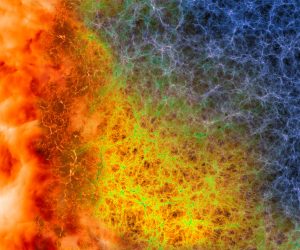
 Two new Department of Energy-sponsored telescopes, the Dark Energy Spectroscopic Instrument (DESI) and the Vera C. Rubin Observatory, will map cosmic structure in unprecedented detail. At Argonne and Lawrence Berkeley national laboratories, teams have developed a pair of the world’s most powerful cosmological simulation codes and are ready to translate the telescopes’ tsunami of observational data into new insights.
The post Berkeley Lab and Argonne Computational Cosmologists Help Astronomers Turn Observation into Insight appeared first on HPCwire.