Expanse Supercomputer Aids in Nanoparticle Assembly Research

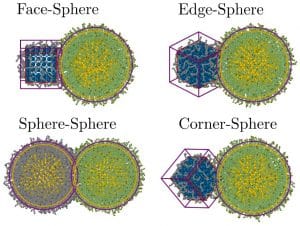
Snapshots of two nanoparticles obtained from the simulations run at Expanse. The cube and sphere interact through faces, edges and vertices.

First discovered in Russia’s Ural Mountains in 1839, perovskites are minerals that scientists have long recognized for their potential around stability and efficiency in materials design. In terms of nanoscience and nanoparticles, perovskites may be able to literally change the world by enabling researchers to develop these materials with traits that seem to outshine those of today’s common materials.

The post Expanse Supercomputer Aids in Nanoparticle Assembly Research appeared first on HPCwire.
More Related Posts

Supercomputers Work Together for Big Science Simulations

How many supercomputers does it take to simulate plasma turbulence? Quite a...

Celltrio provides laboratory automation for COVID-19 fight

Numerous robotics innovators and vendors claim to be joining the fight against...

3 nonsurgical robotics applications to watch in healthcare

The COVID-19 pandemic has renewed and expanded interest in non-surgical healthcare robots...

Home

Highly Niched Headhunters Specialized in Physical AI/Robotics, High-Performance Computing, Unmanned/Autonomous Systems, Defense Technology and Energy.

Specializations

We recruit across complex engineering markets where understanding the technology is critical to finding the right talent.

How We Work

Overview of how PACE partners with teams: Our process, what clients get, and why PACE is different.

About Us

PACE’s story, values, and culture define how we operate and who we are.

News & Insights

Stay up to date on industry trends.

Contact

All the information needed for anyone interested in contacting us.