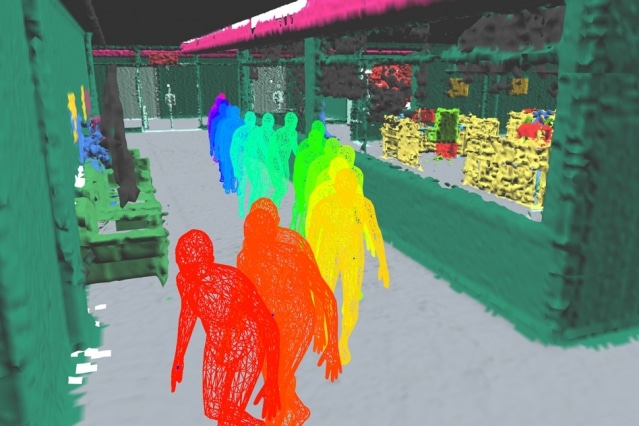
MIT researchers have developed a representation of spatial perception for robots that is modeled after the way humans perceive and navigate the world. The key component of the team’s new model is Kimera, an open-source library that the team previously developed to simultaneously construct a 3D geometric model of an environment. Kimera builds a dense 3D semantic mesh of an environment and can track humans in the environment. The figure shows a multi-frame action sequence of a human moving in the scene. | Credit: MIT
Wouldn’t we all appreciate a little help around the house, especially if that help came in the form of a smart, adaptable, uncomplaining robot? Sure, there are the one-trick Roombas of the appliance world. But MIT engineers are envisioning robots more like home helpers, able to follow high-level, Alexa-type commands, such as “Go to the kitchen and fetch me a coffee cup.”
The post MIT system improves robots’ spatial perception appeared first on The Robot Report.