
Penn State Advances in Quantum Tech: Unveiling New Superconductive Materials

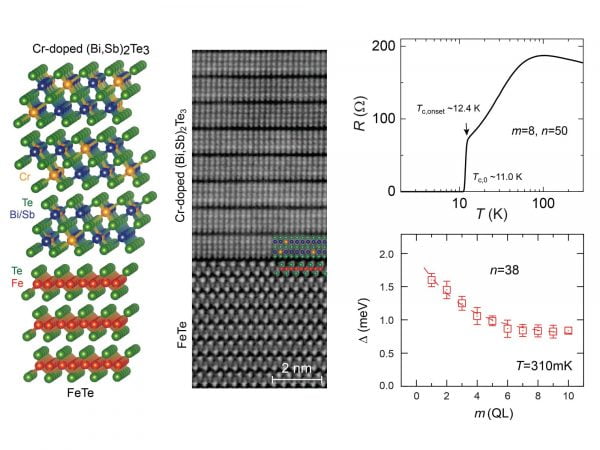
A team led by Penn State researchers has demonstrated superconductivity at the interface between the fusion of two magnetic materials, a ferromagnet (Cr-doped (Bi, Sb)2Te) and an antiferromagnet (FeTe).

A new fusion of materials, each with special electrical properties, has all the components required for a unique type of superconductivity that could provide the basis for more robust quantum computing. The new combination of materials, created by a team led by researchers at Penn State, could also provide a platform to explore physical behaviors similar to those of mysterious, theoretical particles known as chiral Majoranas, which could be another promising component for quantum computing.

The post Penn State Advances in Quantum Tech: Unveiling New Superconductive Materials appeared first on HPCwire.


More Related Posts

U.S. manufacturers invested heavily in robotics in 2023, finds IFR

Total installations of industrial robots rose by 12% and reached 44,303 units...

Scientists Have Pushed the Schrödinger’s Cat Paradox to New Limits | WIRED

A research team in China has held atoms in a state of...

Supercomputing Enables Analysis of Massive Atmospheric Science Datasets

On March 1, 2002, European researchers looked to the sky as the...

Home

Highly Niched Headhunters Specialized in Physical AI/Robotics, High-Performance Computing, Unmanned/Autonomous Systems, Defense Technology and Energy.

Specializations

We recruit across complex engineering markets where understanding the technology is critical to finding the right talent.

How We Work

Overview of how PACE partners with teams: Our process, what clients get, and why PACE is different.

About Us

PACE’s story, values, and culture define how we operate and who we are.

News & Insights

Stay up to date on industry trends.

Contact

All the information needed for anyone interested in contacting us.