
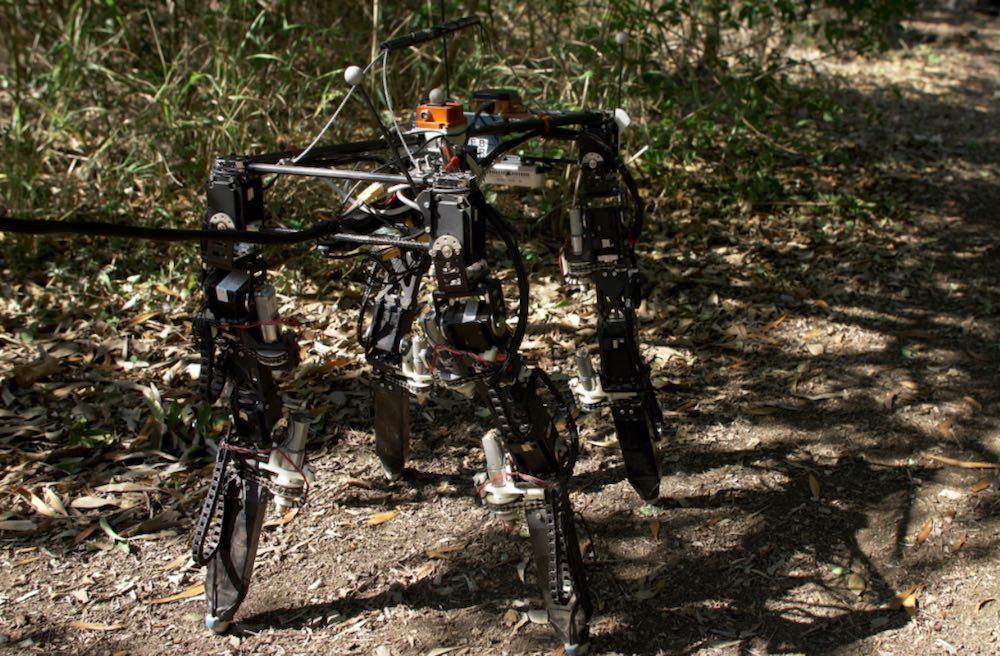
Quadruped learns to adapt its legs to changing terrain

Dyret quadruped

This quadruped, called Dyret, automatically adapts its morphology to different conditions in unstructured outdoor environments.

The four-legged robot Dyret can adjust the length of its legs to adapt the body to the surface. Along the way, it learns what works best. This way it is better equipped the next time it encounters an unknown environment.

The post Quadruped learns to adapt its legs to changing terrain appeared first on The Robot Report.

More Related Posts

Computer-generated Models Mimic Human Recognition at Supersonic Speed

A research team led by Joseph Gleeson, MD, Rady Professor of Neuroscience...

New Algorithm Unlocks High-Resolution Insights for Computer Vision

Imagine yourself glancing at a busy street for a few moments, then...

How Detroit’s fear of Silicon Valley sparked the autonomous vehicle gold rush

Waymo’s lineup of autonomous vehicles. | Credit: Waymo 2020 was supposed to...

Home

Highly Niched Headhunters Specialized in Physical AI/Robotics, High-Performance Computing, Unmanned/Autonomous Systems, Defense Technology and Energy.

Specializations

We recruit across complex engineering markets where understanding the technology is critical to finding the right talent.

How We Work

Overview of how PACE partners with teams: Our process, what clients get, and why PACE is different.

About Us

PACE’s story, values, and culture define how we operate and who we are.

News & Insights

Stay up to date on industry trends.

Contact

All the information needed for anyone interested in contacting us.