Researchers Peer into Dark Matter with MillenniumTNG Simulation

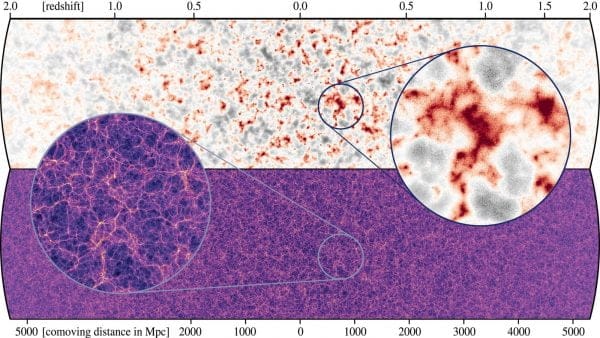
This image shows neutrinos (top) and dark matter density fields (bottom) from a fixed observation point. The MillenniumTNG simulations are allowing researchers to better model and, in turn, understand the ubiquitous yet mysterious neutrinos in our universe. Image credit: Volker Springel and the MillenniumTNG collaboration.

A research collaboration including a team based at the Max Planck Institute for Astrophysics has long leveraged world-class supercomputing resources to understand how our universe came to exist in its current form. Building on the successes of the previous “Millennium,” “Illustris,” and “IllustrisTNG” projects, the researchers are simulating dark matter in unprecedented detail in the context of the “MillenniumTNG” project.

The post Researchers Peer into Dark Matter with MillenniumTNG Simulation appeared first on HPCwire.


More Related Posts

Innovation latency in industrial automation

Many of the world’s great technologies realize their full potential only 50-100...

MassRobotics launches inaugural Robo Boston Festival

Robo Boston will take place in the innovative Boston Seaport neighborhood on...

Data Storage: the crucial ingredient to realizing the benefits of Government AI programs

The federal government is uniquely positioned to leverage massive amounts of data...

Home

Highly Niched Headhunters Specialized in Physical AI/Robotics, High-Performance Computing, Unmanned/Autonomous Systems, Defense Technology and Energy.

Specializations

We recruit across complex engineering markets where understanding the technology is critical to finding the right talent.

How We Work

Overview of how PACE partners with teams: Our process, what clients get, and why PACE is different.

About Us

PACE’s story, values, and culture define how we operate and who we are.

News & Insights

Stay up to date on industry trends.

Contact

All the information needed for anyone interested in contacting us.